ServicesReverse Osmosis System
Reverse Osmosis System Setup for Peoria Homes
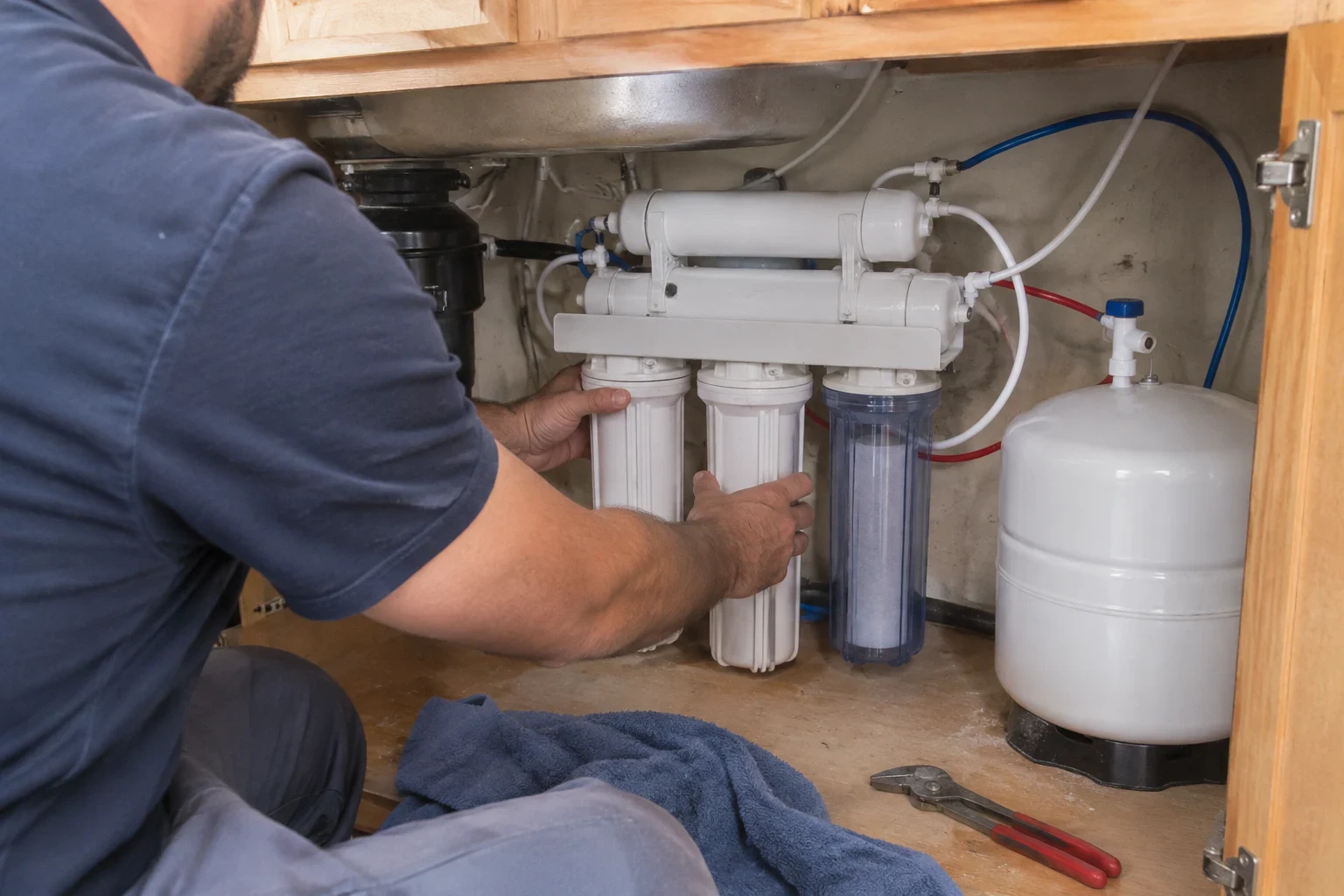
An under-sink reverse osmosis unit puts filtered water at its own faucet for drinking, coffee and cooking. We shut the water off first, cover the cabinet floor, and test each connection for drips before anyone leaves your home.
How reverse osmosis works in your home
The unit lives in the cabinet under your kitchen sink. Tap water passes through a set of filters and then a very fine membrane. The clean water collects in a small tank and comes out of a separate faucet. It carries far fewer dissolved minerals and a lot less of the chlorine flavor some folks pick up in city water.
An RO unit handles one tap. It covers drinking glasses, pots and the coffee maker, but not your showers or laundry. For filtered water throughout the house, see our whole-home filtration page. If crusty fixtures are your main gripe, start with a water softener.
Safety drives how we install it. The unit connects to your cold supply and your drain, inside a cabinet most people seldom open. A loose fitting there can drip for weeks and rot the cabinet floor. We take the time to make each connection tight and dry.
What we do on an RO job
A unit that fits your cabinet
We check the room under the sink, the disposal and how much drinking water your family goes through. The unit we pick still leaves your shutoff valves easy to reach.
Its own faucet at the sink
The RO faucet goes in a spare sink hole, or we bore a new one. Stone and quartz get the correct bit and a slow hand so the edge does not chip or crack.
Air gap on the drain line
Rinse water from the membrane drains into your sink plumbing. We hook it up so sewer-side water has no path back into the filters.
Cold line tie-in with its own valve
We tap the cold supply with a dedicated valve. That way you can turn off the RO by itself and keep the kitchen faucet running.
Flushing and a drip test
The filters and tank get flushed before your first glass. We then inspect every joint under full pressure and set a paper towel beneath the unit so any later drip shows up fast.
Refrigerator and ice maker hookup
We can carry RO water over to the fridge if you like. We plan the path with you first so the tubing does not get crushed when the fridge slides back.
When an RO unit is worth it
- Your recycling bin is full of water bottles
- Carrying cases in from the car every week wears thin. A dedicated faucet puts drinking water right at the sink.
- The water tastes wrong to you
- A chlorine or mineral flavor in plain water, coffee or tea is the top reason folks reach out to us.
- Crusty buildup in the kettle
- Water around the Valley tends to run hard, and those minerals coat anything that heats water. RO water leaves much less behind.
- Ice comes out cloudy
- Minerals in the water cloud up ice and spot your glasses. Sending RO water to the ice maker clears that up.
- An older unit leaks or never shuts off
- If your current RO keeps running to the drain or leaves the cabinet floor damp, get it looked at before the wood swells.
How the job goes
- 1
Talk it through by phone
Tell us about your sink, your countertop and what you want from the water. We go over system options and give you your quote by phone.
- 2
Prep the space
On install day we shut off the water under the sink and lay down a mat and towels. We clear the cabinet only as far as we need to.
- 3
Mount and connect
We mount the filter housings and tank, set the faucet, and make the cold water and drain connections. Tubing is cut square and routed so it will not kink or rub.
- 4
Flush, pressure up and check
We slowly turn the water back on, flush the system, and check each joint for drips. We do not leave until the cabinet stays dry.
- 5
Show you the basics
We show you where the shutoff is, how filter changes work, and what a normal sound or drip at the drain looks like versus a problem.
What changes the cost of an RO install
Most under-sink setups are straightforward. A handful of details push the price up or down, and we cover each one on the phone so the number you hear is the number you pay.
- Which unit you pick
- A unit with a storage tank runs less than a tankless one. A remineralizing stage or a faster membrane adds to the total.
- Countertop material
- If there is already a spare hole in the sink deck, the faucet goes in fast. Boring through granite, quartz or porcelain takes slower, careful work.
- Running water to the refrigerator
- A line to the fridge means extra tubing, fittings and time. The longer the run across the kitchen, the more it adds.
- Cabinet condition
- A cramped cabinet with a disposal and aging valves can mean extra steps, like swapping out a stiff shutoff before we connect anything.
Common questions about reverse osmosis
- Does an RO system send water down the drain?
- It does. The membrane needs a steady rinse, and that rinse water goes to the drain. The amount depends on the unit and your water pressure. Newer models use less, and we can compare options with you on the call.
- Should I get a softener along with the RO?
- You do not have to. An RO unit runs fine by itself. In hard water, a softener upstream keeps scale off the membrane so it lasts longer. Our water softener installation page covers how the two work together.
- How often do filters get replaced?
- The pre-filters get swapped more often than the membrane. Timing depends on your water and how much you draw. We set you up with a schedule on install day and show you how to change them with the supply off so nothing sprays.
- Is the install covered by a warranty?
- Yes. Each RO job we do carries a 2-year labor warranty plus a 2-year installation warranty. Should one of our connections start dripping during that window, give us a call and we will come out and look at it.
- Is water without minerals OK to drink?
- Yes. Your body gets most of its minerals from food, not from a glass of water. Some people like a little mineral taste, and a remineralizing stage can add that back.
Ready for better drinking water
Call and tell us about your kitchen sink. We will talk through the right system and what the install involves.